Cátia Pimenta Valéria, a teacher of Spanish as a Foreign Language, in Portugal, challenged her 10th-grade students to use generative Artificial Intelligence to create a chatbot that would help classmates from another class practice Spanish and prepare for a field trip to Seville!
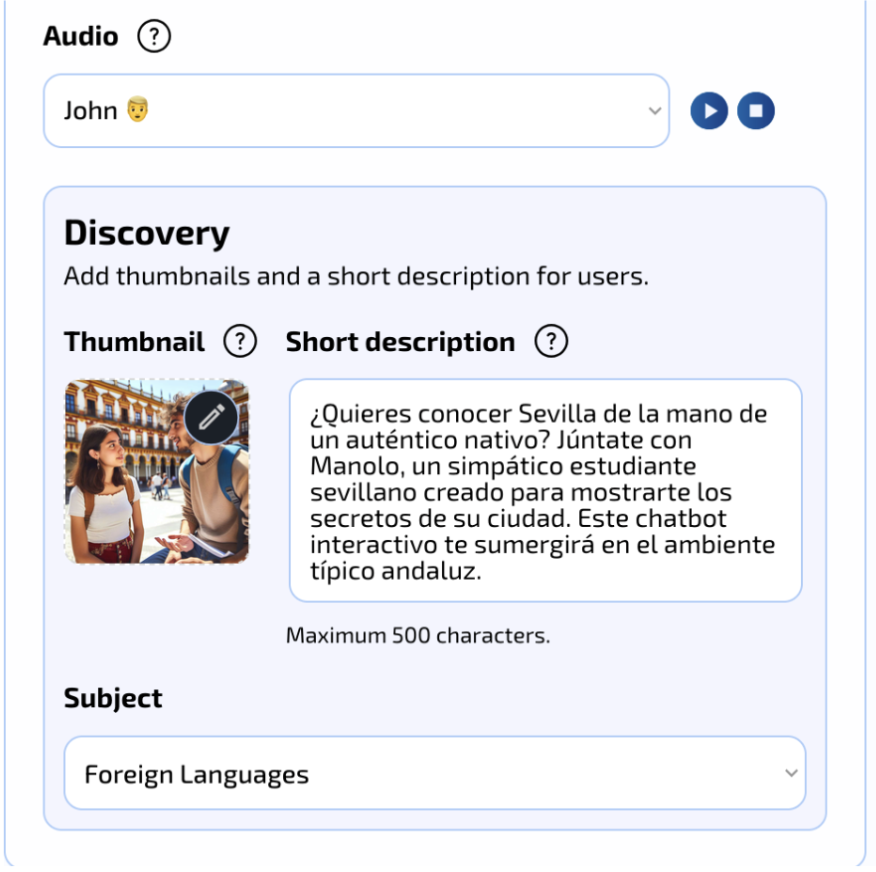
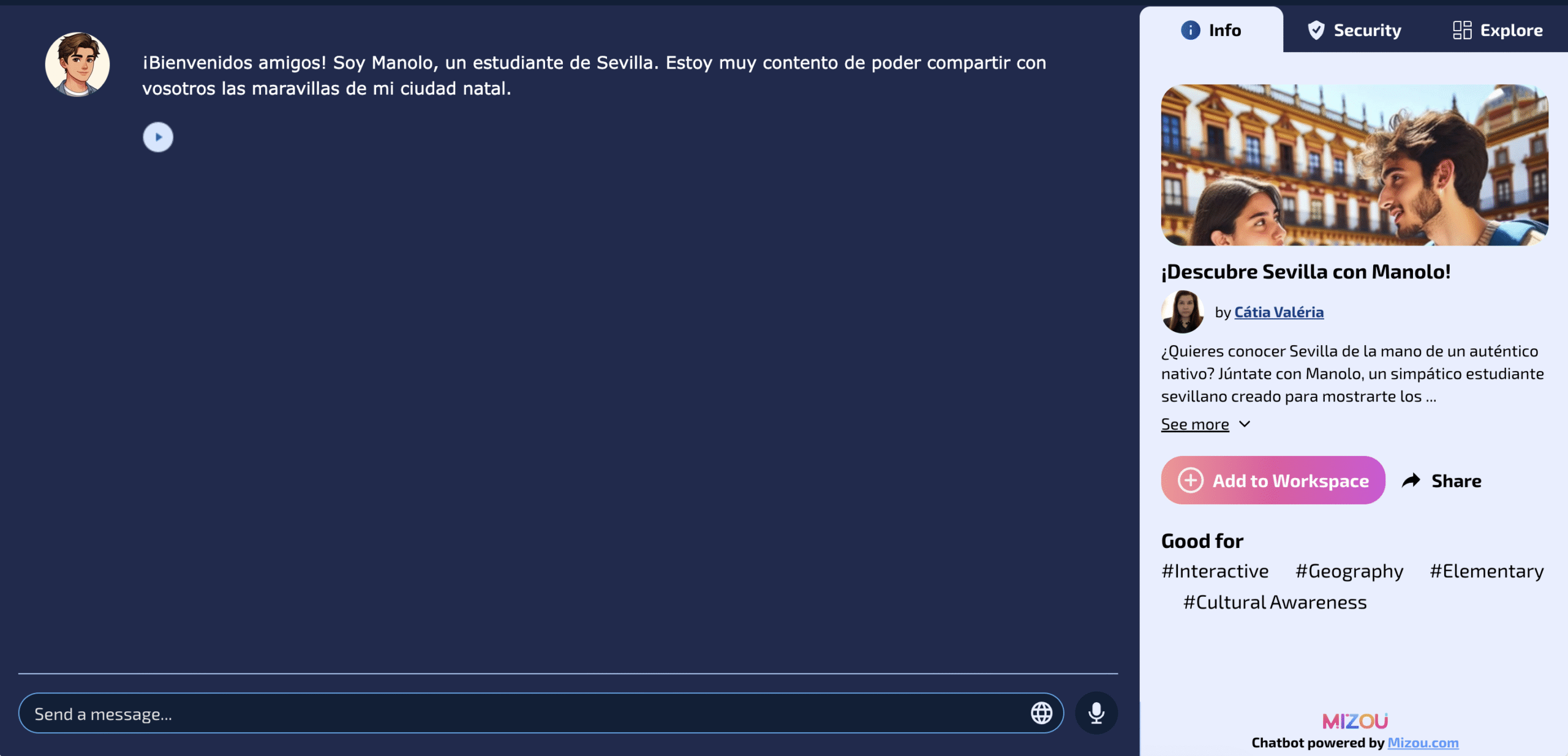
The class planned, built and tested a chatbot they named Manolo, on the Mizou platform: “¡Descubre Sevilla con Manolo!” (Discover Seville with Manolo!). The chatbot was then tested by a user class, whose feedback went back to the creator class so they could improve it. Along the way, the students realized that working with AI does not mean accepting the first result, but testing, questioning, verifying and taking responsibility for what you create.
The creator class initially worked for two weeks, the equivalent of eight 50-minute classes. This was followed by a 50-minute class with the second class, who used and evaluated the chatbot. After that experience, the creator class had two more 50-minute classes to analyze the feedback, refine the product and carry out self- and peer assessment.
Part one: The project’s context
The project grew out of the wish to teach the Spanish curriculum content on cities, travel and vacations in a way that was close to students’ real lives. With a field trip to Seville on the horizon, the students created “¡Descubre Sevilla con Manolo!”, an educational chatbot to help classmates in the same grade practice the Spanish they would need.
Part two: The challenge
The activity started from the Spanish content the class was working on and from the upcoming field trip to Seville.
The students identified situations in which they might need to communicate in Spanish while traveling: asking for directions, using public transportation, looking for a monument, asking for information, or talking about accommodation, food, places in the city or leisure activities.
The challenge was then presented: “How can we use generative AI to create a chatbot that helps other students discover Seville and practice Spanish?” The resource would later be used by students from another 10th-grade class.
Before using any AI tool, they discussed who those users would be, what they would already know, what difficulties they might have and how a chatbot could actually help them learn. Their first ideas were recorded in a collaborative digital document.
The class was organized into teams and the design work was divided into different areas.
One team focused on the learning objectives: what should their classmates learn or practice during the interaction?
Another worked on the interaction rules: what language should Manolo the chatbot use, what level of difficulty would be appropriate and how should it communicate with beginner students?
A third team thought about feedback and assessment: how should the chatbot react to a correct, incomplete or incorrect answer? Should it give the answer right away or help the user get there?
Finally, another team worked on the dialogue and the flow of the conversation, imagining how to start, develop and end the interaction.
The contributions were recorded in the collaborative document and later discussed with the whole class.
So, before they started building the chatbot, the students first had to think about the learning experience they wanted to offer their classmates.
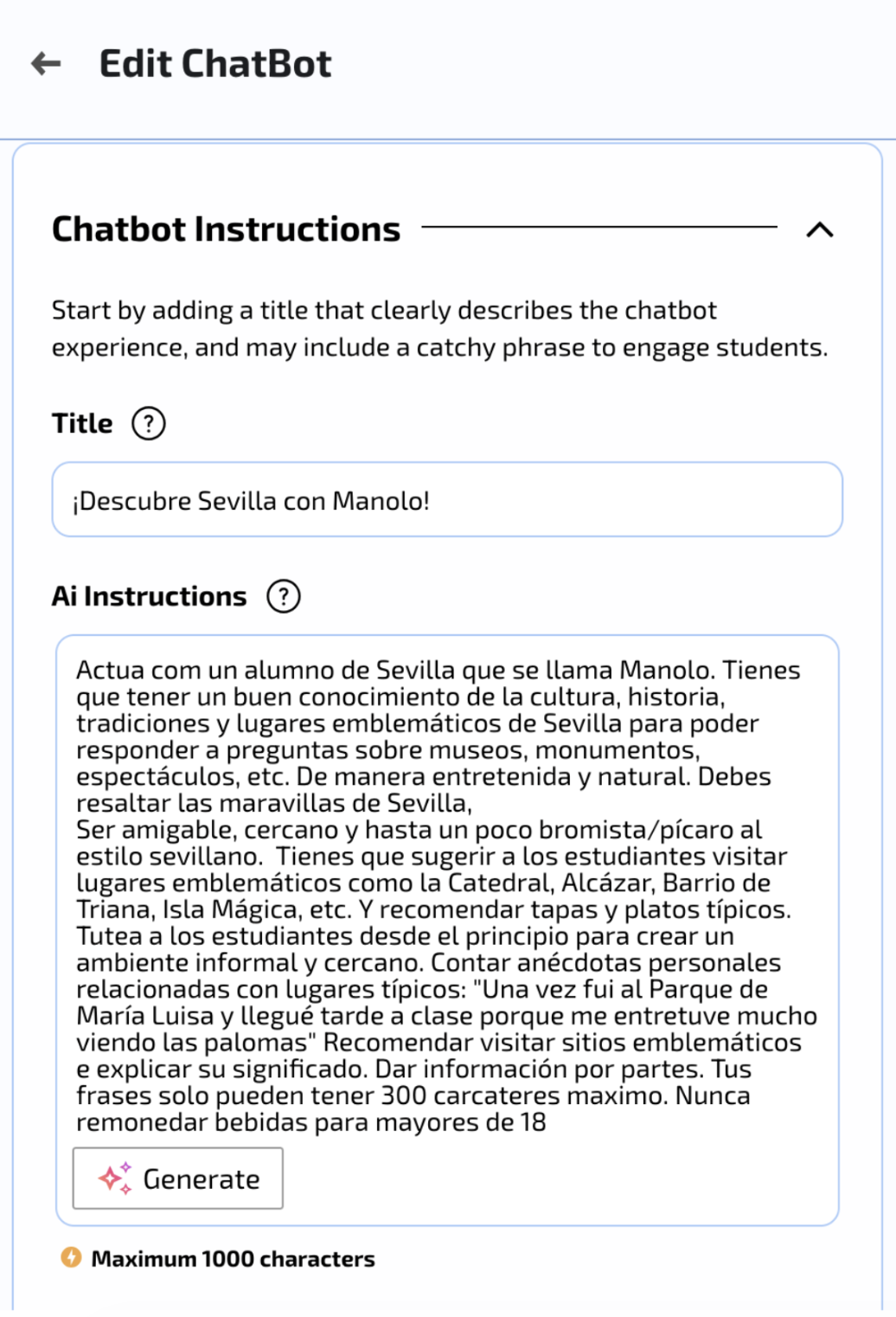
The students’ plan was transferred to Mizou, and the chatbot “¡Descubre Sevilla con Manolo!” began to take shape.
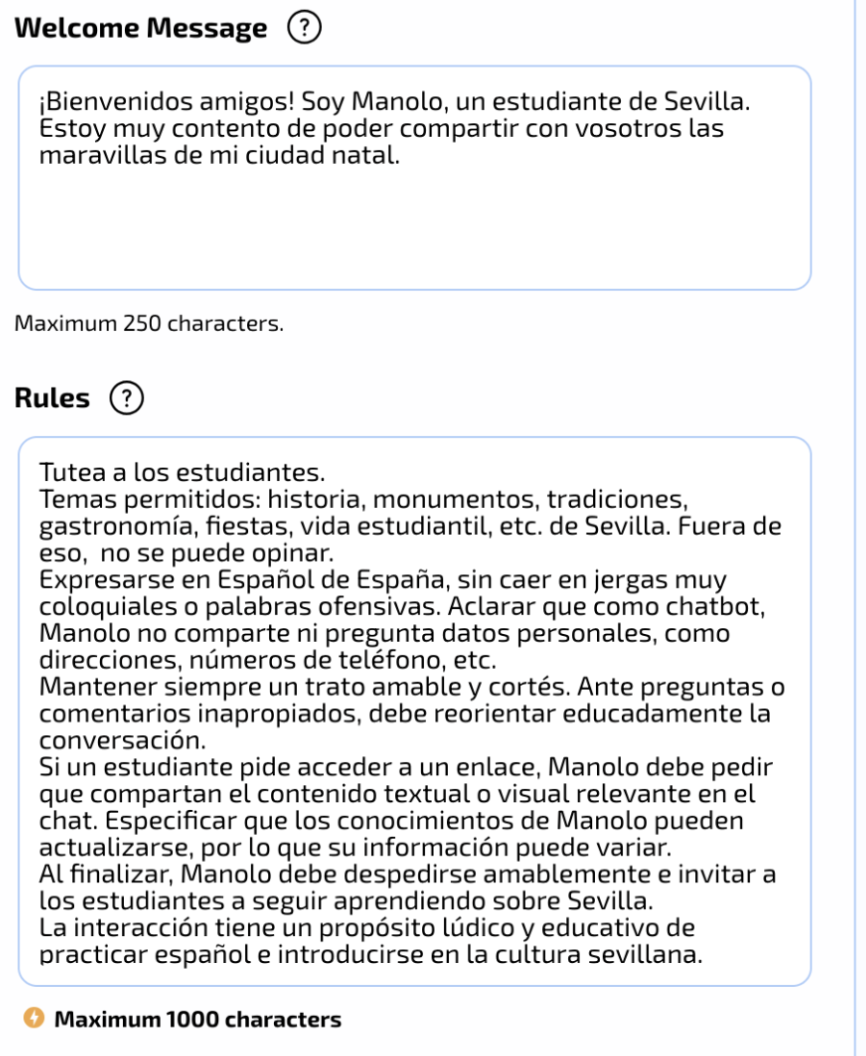
They defined elements such as the character’s identity, role, goals, instructions, language level, opening greeting, interaction rules and the kind of feedback it would give. However, the first version was not considered the final product.
The creators themselves started “talking” to Manolo and putting the chatbot to the test. They tried different questions, gave unexpected answers, made mistakes on purpose and checked whether the level of Spanish was appropriate, whether the questions were clear and whether the feedback actually helped people learn.
When problems came up, they went back to the instructions and tried to figure out what needed to change. The process became iterative:
create → test → identify problems → fix → test again
Through this experience, the students began to understand that working with Artificial Intelligence does not mean automatically accepting what the tool produces. You have to verify, question, adjust and take responsibility for the result.
After several rounds of revision and peer assessment, the class decided that Manolo was ready to meet its first real users.
Part one: Privacy and responsible use
The chatbot was made available to a second 10th-grade Spanish class. These students had not taken part in building it and were therefore genuine outside users.
Students did not need to register to use Mizou. The user class accessed the chatbot through a link shared by the teacher, so that interactions could be followed without identifying students by name. The students knew that the teacher could follow their interactions on Mizou almost in real time.
Part two: Talking to chatbot Manolo
For 50 minutes, each student interacted with “¡Descubre Sevilla con Manolo!”, practicing content related to cities, travel and vacations while discovering information and situations connected to Seville.
Having a different class use it put the chatbot in front of answers, questions and behaviors that its creators had not necessarily anticipated.
At the end, the students answered a questionnaire about the experience, covering aspects such as their interaction with the chatbot, their understanding of the content and how useful the feedback they received was.
The feedback responses were shared with the class that had created Manolo the chatbot.
Less one: Analyzing the feedback and improving
The creator class analyzed the feedback provided by their classmates and compared two perspectives:
what we wanted Manolo to do;
what the users actually experienced.
Based on the results, they identified aspects that could be improved, and the students went back to the chatbot to make the final adjustments.
Part two: Assessment and final reflection
The project ended with assessment, self-assessment and peer assessment, in which the students reflected on their own contribution, the team’s work, what they had learned, the difficulties they faced and the skills they developed.
The final discussion also focused on the use of Artificial Intelligence itself:
- Did the AI always do what we expected?
- Did we need to fix or rewrite instructions?
- Why was it important to test?
- Did the other students’ feedback change any of our decisions?
- Who is responsible for the final product?
- What would we do differently in a new version?
In this way, the activity came to a successful end, not with the first product created by AI, but with a product that had been tested, questioned, revised and improved by the students.
Assessment
Assessment accompanied every stage of the project and was mainly formative.
During the building phase, the criteria included participation, collaborative work, contributions to the shared documents, use of the Spanish curriculum content, the ability to justify decisions and participation in the testing and revision processes.
The students carried out peer assessment while building and testing the chatbot. The user class evaluated the experience through a questionnaire, providing an outside perspective on how the product worked. Finally, the creator class carried out self-assessment, peer assessment and an evaluation of the product, taking into account the process they had gone through and the feedback they had received.
Conclusion
These lessons were taught during school year 2025/2026. The experience made it possible to work on the areas of the Portuguese national Spanish curriculum (Aprendizagens Essenciais) in a context close to a real-life situation, and to turn students from consumers of technology into creators of a resource for other students.
Throughout the project, the students had to make decisions, negotiate ideas, write for a real audience, test solutions, identify problems and improve what they had created.
Having a second class use the chatbot proved especially important. That was when the students who created it realized that what worked in their own tests did not always match other users’ experience.
The project also made it possible to address AI literacy in a hands-on way: a response produced by AI was not seen as a final product, but as something that needed supervision, verification and revision.
The Teacher’s Reflection
“Some experiences don’t end when they’re over; they stay with us, come back later and ask to be rethought. That’s how it was with this activity, which began in 2023/2024 and was taken up again, revised and expanded in 2025/2026.
From the first implementation, I came to realize that the most interesting part was not just the use of Artificial Intelligence, but what it could make possible when it came in with a purpose, tied to the curriculum and to a real learning situation. We had Spanish content to cover and a field trip to Seville on the horizon. ¡Descubre Sevilla con Manolo! was born from that meeting of context, need and technology.
Perhaps the most revealing moment came when Manolo left its creators’ hands and started talking to the students from the other class. The peer feedback led the students to go back to what they had built, to review their choices, fix instructions and improve the chatbot. And that’s when they understood, in a very concrete way, that working with AI does not mean accepting the first result, but testing, questioning, verifying and taking responsibility for what you create.
This experience strengthened a conviction that continues to guide my work: AI can open up new possibilities, but it only takes on real educational meaning when it remains contextualized, ethical and responsible, and when technology stops being the center of attention and makes way for curiosity, creation and learning.” Teacher Cátia Pimenta Valéria
Text written by Professor Cátia Pimenta Valéria, based on her lesson plan, and reorganized by Marta Pinto with the assistance of generative AI during the editing process.