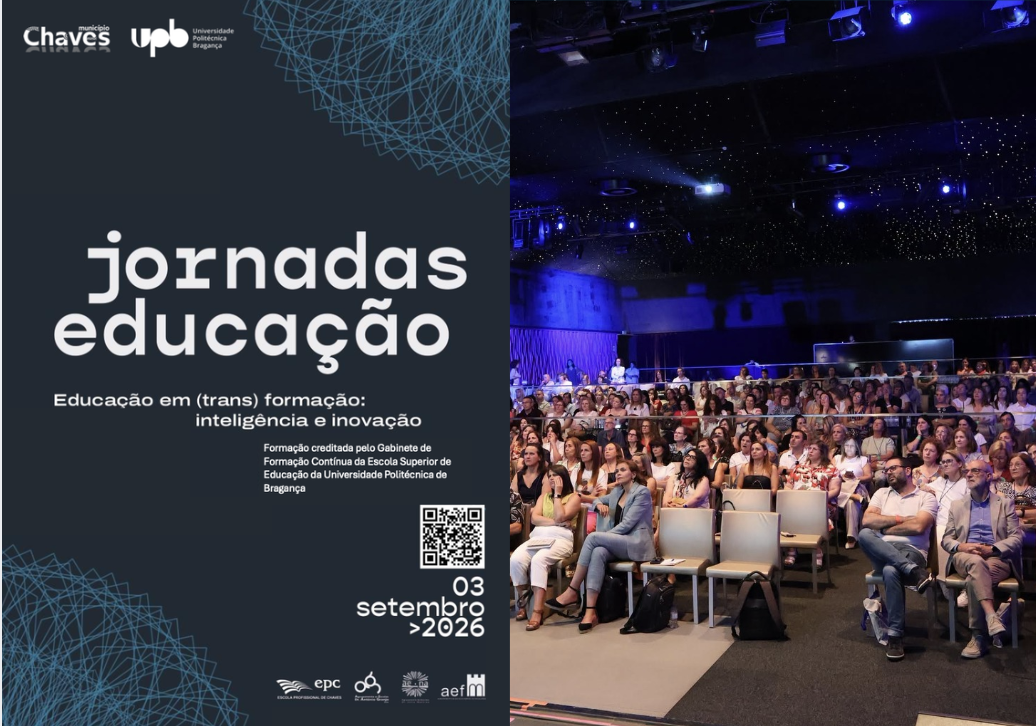
Event: III Jornadas de Educação of Chaves, opening of the school year session
Date: September 3, 2026
Location: Chaves, Portugal
Organized by: Chaves City Council & University Polytechnic of Bragança
Speaker: Marta Pinto, AI goes to School
Founder Marta Pinto joined the opening of the school year at Chaves’ III Jornadas de Educação with a session on the impact of AI on learning, entitled “Attention in Fragments(?): the neuroscience of focus in an ecosystem of notifications, screens, and AI.”
As often happens with this topic, people want a simple answer: is AI good or bad for learning? What the research actually shows is more useful than that.
Three ideas sat at the heart of the conversation:
- Protecting learning is the priority.
A learning design can advance learning more or less. When AI is integrated, the way it’s done can also protect learning or neglect it, depending on how it’s used. What science shows: MIT study (Kosmyna et al., 2025) showed that writing first and only then turning to AI preserves brain activity and retention; doing it the other way around doesn’t. I also shared two recent studies on Khanmigo, Khan Academy’s AI tutor: the first, a large-scale, 2-year study (Oreopoulos & Low, 2026), found that giving students access to the tutor wasn’t enough to improve learning; the second, by the same authors (Oreopoulos et al., 2026), revealed why — when the tool’s design forces the student to put in the effort (for example, only letting them move on after answering correctly), results improve.
Take-away: teachers downloaded the slides summary, to take into the classroom and show their students to reflect together. - The answer isn’t banning AI. It’s redesigning.
Shifting from activities centered on the final product to activities centered on process, discussions, portfolios, reflection, peer feedback, grounded in three simple principles: intentionality, transparency, dialogue.
Take-away: teachers a list of AI-resistant activities, ready to adapt to any subject. - What’s already happening, in real classrooms.
Shared real teachers’ lesson plans, with activities tested in classrooms taught about AI literacy and how to use generative AI to support learning. From primary school when 8-year-olds tested whether a chatbot “gets things wrong,” to secondary school students using AI to propose real environmental solutions for their community.
Take-away: teachers kept summary cards for each lesson plan, with links to the full plans for anyone who wants to go deeper.
Teachers actively participated, asking questions and sharing their own experiences with AI in the classroom, which is always a moment for validating the incredible work they are already doing. In their own words, the session brought new ideas to apply in lessons, learning, lightness, hope, confidence in AI’s potentialn and “all intelligences complement each other.”
A great thanks to the Chaves City Council and University Polytechnic of Bragança for the invitation, and to colleague panelists with whom the conversations about research and AI in education connected us: Patricia Oliveira-Silva, Ana Luísa Cardoso and Rogério Martins.
Would you like to bring this conversation to your school, school cluster, or municipality? Get in touch, for teachers, or for students and families.
Further reading
Kosmyna, N., et al. (2025). Your Brain on ChatGPT: Accumulation of Cognitive Debt when Using an AI Assistant for Essay Writing Task. MIT Media Lab. arxiv.org/pdf/2506.08872
Oreopoulos, P., & Low, N. (2026). One Click Away: AI Tutoring with Khanmigo in a Two-Year School Experiment. NBER Working Paper 35620. https://edworkingpapers.com/ai26-1551
Oreopoulos, P., Liut, M., Sungu, A., & Low, N. (2026). Making AI Tutoring Productive: Evidence from a Mastery-Based Math Practice Experiment. EdWorkingPaper No. 26-1552.