
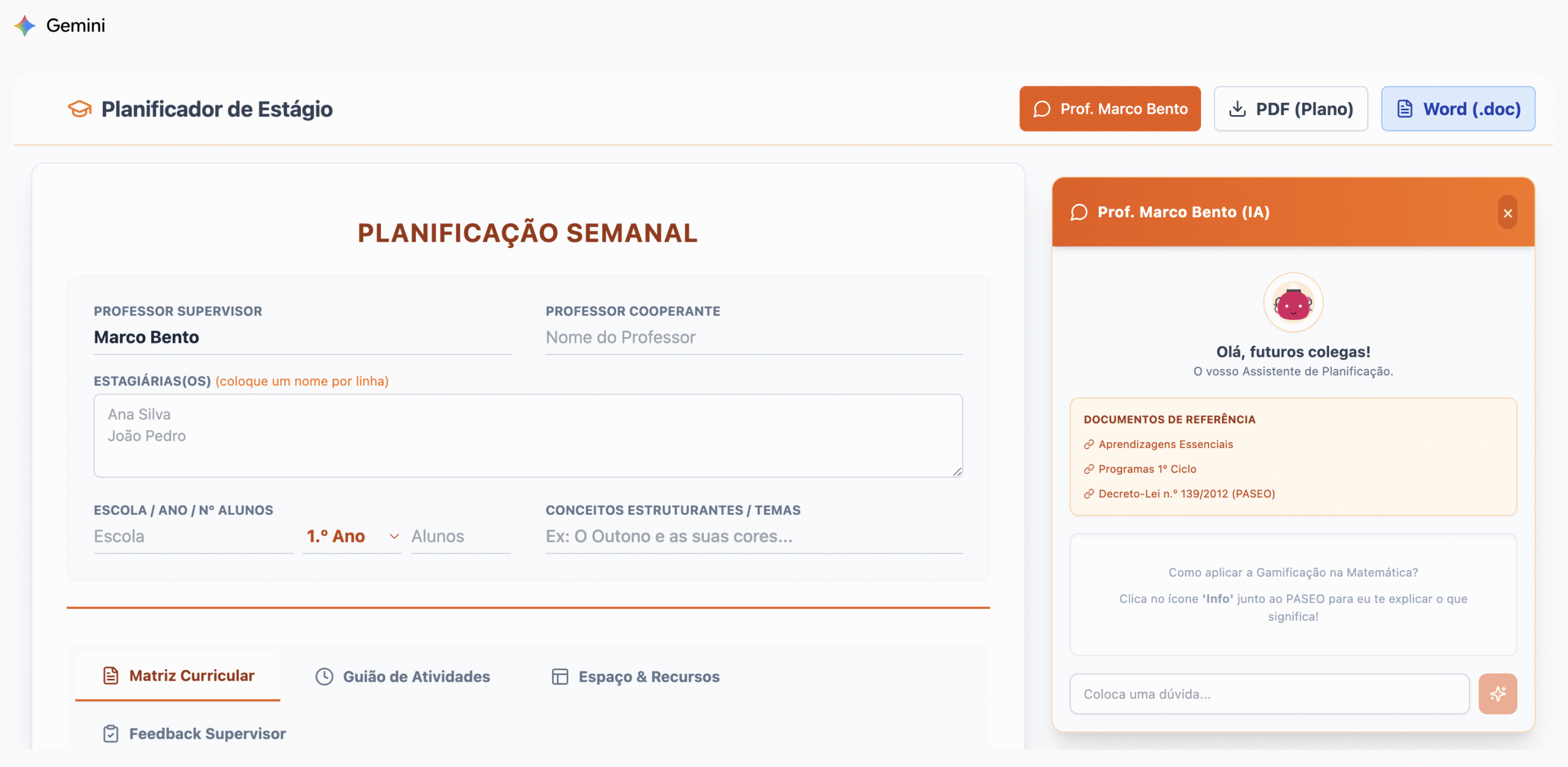
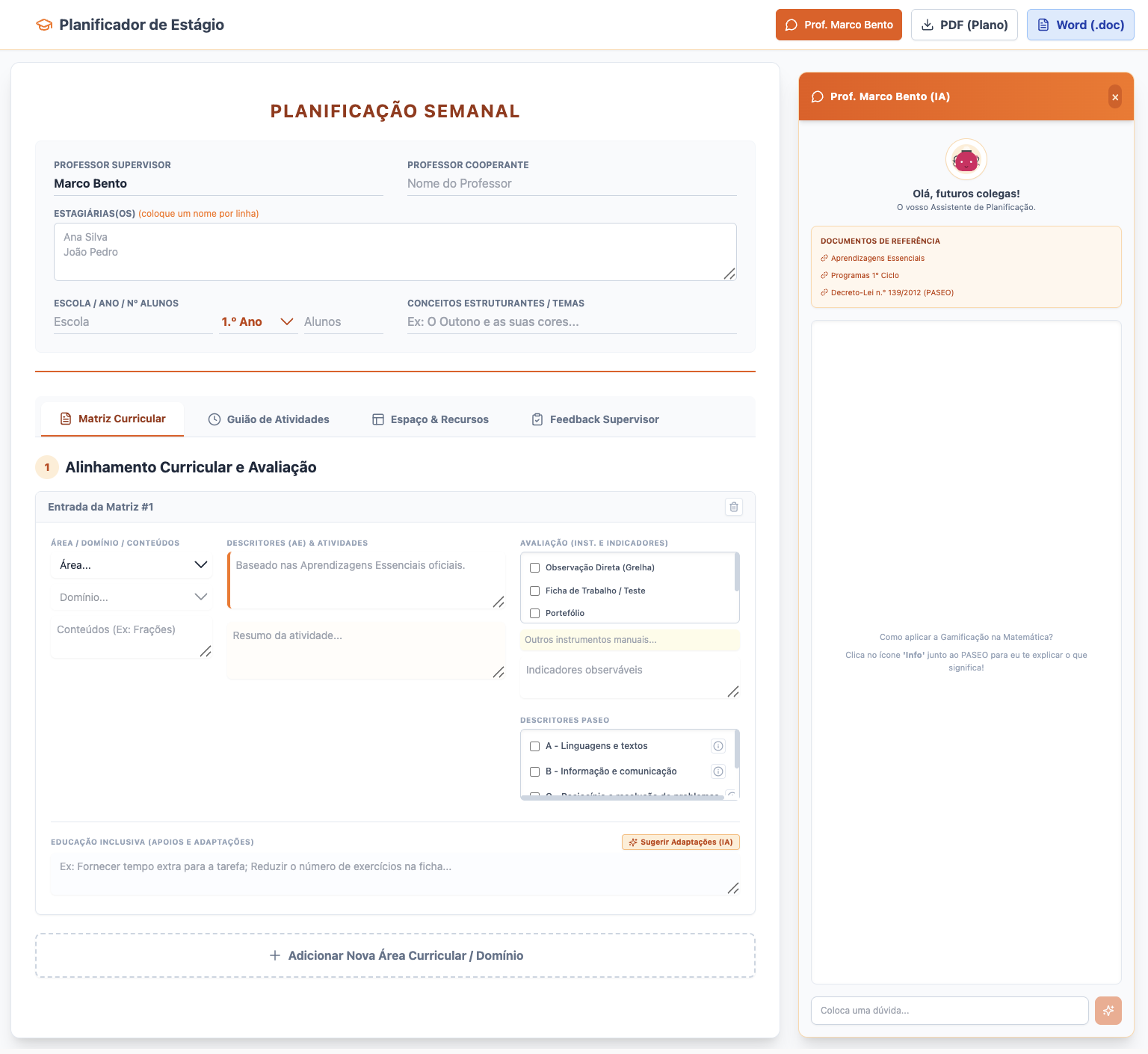
Professor Marco Bento, in the Educational Technology and Educational Observation and Intervention courses, challenged his third-year students in the Bachelor’s degree in Basic Education at the Coimbra School of Education (Escola Superior de Educação de Coimbra) to use generative AI to build a smart planner in Gemini, which they called the AI tutor, to help them prepare for their teaching practicum in primary school (1st cycle of basic education, grades 1 to 4)!
Over 10 lessons, the class built, tested and improved an AI tutor in Gemini to help them develop their lesson planning. The main goal was to create an activity in which students would develop AI literacy and prompt literacy and, above all, the pedagogical thinking that the prompt forced them to make explicit. The approach was based on collaborative design and building, in which the process of building the tool itself became the object of learning. The experience started from a guiding question: “How can we use Artificial Intelligence not to replace a future teacher’s ability to plan, but to help them think through their planning better?”
Lesson 1: Generative AI and the teaching profession
This lesson started from a guiding question: “Which of a teacher’s tasks could be supported by AI?” The class was guided through a moment of reflection on planning, materials, differentiation, assessment and feedback.
Next, the students freely experimented with the generative AI tool Gemini, asking it for a simple lesson plan. Example: “Create a Social and Natural Sciences lesson for a 3rd-grade class on the water cycle.”
After each person had generated an output, they carried out a joint critical analysis, trying to answer these questions:
- Does the proposal follow the national curriculum guidelines?
- Does it know the class?
- Is there interdisciplinarity?
- How are the students assessed?
- How does it respond to diversity?
- Where did the objectives come from?
- Can we automatically trust the answer?
One of the goals was for them to understand AI as a tool that supports a teacher’s thinking, not as a substitute for it. A generic prompt often produces a generic answer: the pedagogical quality of the response generated by Gemini depends on the pedagogical quality of the questions the teacher asks. The students learned to recognize the potential and limitations of generative AI systems and to communicate intentionally through prompts, analyzing each AI-generated response, which was discussed, validated and, when necessary, rejected or reworded.
Lesson 2: Prompt literacy
In this lesson, the students worked in groups. Each group received ineffective prompts and worked on improving them.
A progressive model was developed: Role + Context + Task + Reference documents + Constraints + Format + Quality criteria
The results obtained by each group were compared. The key concept to take away was prompting as an iterative dialogue rather than a single question.
Initial example of an ineffective prompt: “Make a lesson about healthy eating.”
Example of a reworded prompt:“Take on the role of a primary school teacher. Help me draft a proposal for a 3rd-grade class, combining Social and Natural Sciences and Portuguese, on healthy eating. Take into account the national curriculum guidelines for both subjects, include a 20-minute collaborative activity and suggest ways to collect evidence of learning. Don’t write the full lesson plan yet. Start by proposing three methodological options and explain the advantages of each one.”
Lesson 3: Teaching AI the curriculum
In this lesson, the students took on the role of generative AI experimenters, testing two situations:
Situation A: asking the AI for a lesson plan without any documents.
Situation B: asking the AI for the same lesson plan, requiring it to be grounded in the reference documents provided.
The Aprendizagens Essenciais (Essential Learnings) are Portugal’s curriculum guidelines for planning, teaching and assessing learning, and are aligned with the competencies set out in the Students’ Profile. The Students’ Profile is a reference for organizing the education system and for aligning decisions on curriculum development. Decree-Law No. 55/2018 sets the framework for the basic and secondary education curriculum and the guiding principles of assessment, while Decree-Law No. 54/2018 establishes the legal framework for inclusive education.
Example prompt: “Analyze the Essential Learnings provided. List only the learning outcomes that could be used in an interdisciplinary sequence on sustainability for 4th grade. Don’t make up references. Whenever you don’t find enough information in the documents provided, state that limitation explicitly.”
They then compared the two situations in terms of:
- objectives;
- competencies;
- activities;
- curriculum language;
- accuracy of references;
- possible “hallucinations”.
Lesson 4: From curriculum to interdisciplinarity
The students created a learning situation involving at least three curriculum areas, following the example of the topic “Water in the community”, with a possible connection between Social and Natural Sciences, Portuguese, Mathematics and Visual Arts.
Example prompt: “Starting from the topic ‘Water in our community’, identify pedagogically justifiable connections between Social and Natural Sciences, Portuguese and Mathematics for a 4th-grade class. Don’t try to include subjects just to increase interdisciplinarity. For each connection you propose, explain why it contributes to learning.”
The students were asked to use AI as a brainstorming partner, critically evaluating each iteration and deciding on the relevance of the results generated.
Lesson 5: Context, school and class
In this lesson, each group was asked to work with the context of their practicum school, using that information to adapt the proposal generated in the previous lesson.
Example prompt: “Based on the educational project provided and the characteristics of this class, identify three elements that should shape the lesson planning. Don’t create activities yet. Give a pedagogical justification for each element.”
Then: “Now review the previous proposal and explain how the activities could respond to the specific characteristics of this class.”
The key shift this activity aimed for was that students would stop asking “What lesson can I teach?” and start asking “What learning experience makes sense for my students, in this context, with these objectives?”
Lesson 6: Inclusion and differentiated instruction
In this lesson, the students worked on integrating inclusive education into their planning, using as a reference Decree-Law No. 54/2018, which sets out a framework for inclusive schools that seeks to respond to students’ strengths and needs under conditions of participation and equity. They were asked to analyze the planned activities in order to anticipate barriers to learning.
Example prompt: “Analyze this activity as an inclusive education specialist. Identify possible barriers to participation, understanding and expression of learning. For each barrier, suggest changes that would increase everyone’s participation without lowering the learning objectives.”
Then the students compared an inadequate prompt, “Adapt this activity for a student with difficulties.”, with a pedagogically oriented prompt, “Identify barriers in the activity itself and suggest different ways of accessing, participating in and demonstrating learning.”
The key shift this activity aimed for was to move the focus from the student’s deficit to the design of learning.
Lesson 7: Building the AI tutor
In this lesson, the students brought together what they had learned in previous sessions and defined how the AI tutor would work, gradually configuring it with the national curriculum guidelines, the Students’ Profile, Decree-Law 54/2018, Decree-Law 55/2018, the schools’ educational projects, the course assessment criteria, the expected structure for lesson plans, guidance on interdisciplinarity, principles of differentiation and feedback mechanisms.
Example of a core prompt: “Your role is not to write the plan for the student. Your role is to help them improve the plan. Whenever you receive a lesson plan, start by identifying its strengths and the issues that need revising. Ask questions that lead the student to justify their decisions before you offer alternatives.”
The key shift this choice aimed for was that the AI tutor would stop working as an automatic generator of lesson plans or activities and become more like a digital Socratic tutor.
Lesson 8: Feedback and assessment criteria
In this lesson, the students were asked to explore the assessment of their own work as an integrated part of the course. Using the course assessment criteria provided, they used the AI tutor they had built in Gemini to analyze the lesson plan they had created in previous lessons.
Example prompt: “Analyze this plan according to the assessment criteria provided. For each criterion, present: 1. evidence identified; 2. strengths; 3. areas for improvement; 4. a question that leads the student to reconsider their decision. Don’t assign a final grade, but suggest the necessary changes, based on Professor Marco’s and the course’s assessment criteria for a lesson plan.”
The work cycle proposed to the students was: plan, submit, receive feedback, analyze, revise and resubmit. In this way, generative AI was integrated as a support tool throughout the process of producing their work, not just at the end.
In this lesson, the AI tutor was tested by users with a profile similar to its future users: students from other third-year education degree classes who were taking the Educational Technology course but not Educational Observation and Intervention. Each user was asked to carry out a set of tasks:
- create a new lesson plan;
- ask for suggestions on interdisciplinarity;
- submit an existing plan;
- request feedback;
- improve an activity;
- ask for inclusive alternatives.
During the tests, the students followed observation indicators to see whether the user understood what to do and to assess the quality of the results generated by the AI tutor:
- Does the user understand what to do?
- Does the AI tutor ask relevant questions?
- Are the answers too long?
- Does the tool tend to do the work for the student?
- Are the curriculum references appropriate?
- Is the feedback understandable?
- Is the user actually able to improve the plan?
By analyzing their observation data, the students identified when users had more or less difficulty interacting with the AI tutor and how they perceived the quality of the results, gathering the information they needed for new cycles of improving the AI tutor’s design and rewriting its prompts.
The key shift this activity aimed for was that mistakes would no longer be seen as failures but as information for design.
In this lesson, each student was asked to use the developed version of the AI tutor in Gemini to work on a real practicum situation. The process had to show the initial idea, the dialogue with the AI tutor, the feedback, the changes made, the final version and the reasons behind each decision.
The class reflected together on their experience of planning lessons with the help of the AI tutor, based on these questions:
- Where did the AI improve our thinking?
- Where did it introduce inappropriate suggestions?
- Which suggestions did we reject?
- What necessarily remained the teacher’s decision?
- At what point did we stop “using Gemini” and start exercising pedagogical thinking through Gemini?
The record of interactions with the AI tutor itself became a learning artifact, because it made it possible to observe how each student’s pedagogical thinking was built.
Conclusion
This curricular unit was developed during academic year 2025/2026. More than getting “the best answer from Gemini”, this experience focused on how future teachers think about and justify their lesson planning. By building their own AI tutor, fed with curriculum reference documents, schools’ educational projects and the course assessment criteria, the students began to make objectives, context and criteria explicit, to check the AI’s suggestions against curriculum documents, to anticipate barriers to the participation of all students and to revise their plans in successive feedback cycles, without this replacing the professor’s guidance and assessment.
Along the way, they realized that a linguistically convincing answer can be pedagogically wrong and that the pedagogical decision remains the teacher’s. Reflection on privacy, bias, authorship and professional responsibility ran through all the work, in line with UNESCO’s recommendations for a human-centered use of AI and with the need for AI literacy set out in the European AI Act. The object of learning was not the prompt, but the pedagogical thinking that the prompt forced them to make explicit.
The pedagogical paradox of the experience: the more skilled students become at using AI, the less they should accept what AI presents to them without questioning it. A future teacher cannot delegate to a technology the interpretation of the curriculum, knowledge of their students, the teaching relationship, didactic decisions, professional assessment and ethical responsibility. They can, however, use technology to make those decisions more explicit, better grounded and more carefully considered.
The Professor’s Reflection
“This experience led me to a central reflection: perhaps one of the most important skills for future teachers is not knowing how to get answers from Artificial Intelligence, but knowing how to ask pedagogically intelligent questions.
Over these ten sessions, the most interesting change did not really happen in the tool. What changed was the way students thought before writing a prompt.
In the first experiments, the tendency was to ask the technology for a product: “Make a lesson plan.” Gradually, they began to provide context, set criteria, question options, ask for justification and, above all, disagree with the answers they were given, and that is perhaps where the most important learning lies. The experience supports a clear principle: Gemini does not plan for the teacher, but it creates the conditions for teachers to question their own planning more deeply. The pedagogical value of the tool, therefore, does not lie in how quickly it produces a sequence of activities, but in the quality of the interactions it is able to spark.
The AI tutor should constantly be able to ask: “Why did you choose this strategy?”; “What evidence will show that the students have learned?”; “Will everyone be able to take part?”; “How does this activity relate to the learning you defined?” That is when AI stops working merely as a technology for production and starts working as a technology for thinking.
Another important reflection has little to do with AI and more to do with project-based and mainly active methodologies: the students did not simply receive an application, they built it. They were part of the process and defined the problem, the sources, the rules, the prompts, the criteria, the expected behaviors, the limits, the feedback mechanisms (which they value as students) and the testing processes. They therefore went from being consumers of Artificial Intelligence to critical designers of an AI-based educational solution, a path very close to the most advanced level (Create) identified by UNESCO in its AI competency framework for teachers.” Professor Marco Bento
Text written in collaboration with Professor Marco Bento, based on his lesson planning, with support from generative AI for review and summarizing.