
There are new developments in AI in education every week. Our newsletter is here to track, select, and explain what really matters, so teachers don’t have to do it on their own.
Try this!
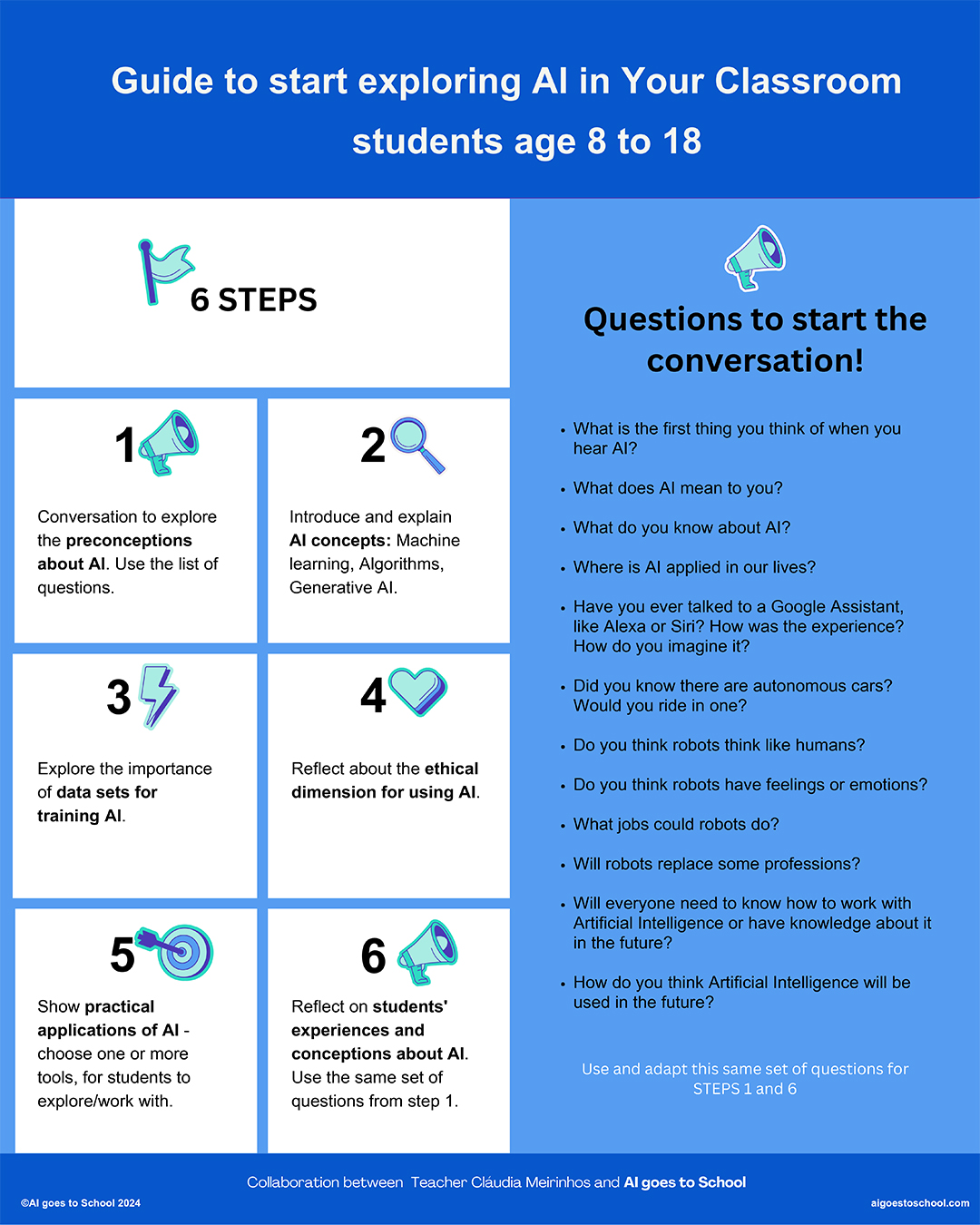
Talking about AI with students ages 8 to 18. The school year is about to begin! To talk about AI with your students, follow this guide with its 6 steps and 9 questions to explore AI at a pace that makes sense for your classroom. You can always revisit each step as everyone gains confidence in exploring AI.
Teacher Stories
26 students in one classroom? Basque teacher Amaia Urruzmendi Zendoia has been teaching for 37 years, and she hasn’t always been a fan of AI in the classroom. She changed her mind when she realized she could never provide real-time feedback to more than 25 students at the same time and on her own. So she created Kontari: 10 to 11-year-old students first sketch out their story as a comic strip, then describe it, and only then write it down. The app highlights what’s still missing. The stories turned out to be more detailed than ever. It has its limitations, but it’s still worth it. As she says, the tool multiplies her efforts 26-fold.
Students Stories
Using AI for good. Hyunseo Lee and Grace Connelly, high school students (from Virginia, U.S.), developed Scammer Slammer, an app that detects scams in messages, emails, and ads, featuring four educational modules on how to recognize online scams.
Students Against AI. Australian high school and college students protested against the construction of a data center, expressing concerns about the environmental impact and the use of AI in schools without clear guidelines.
News
Portugal: Dictionary Priberam already uses the new soberan portuguese LLM named AMALIA, to generate example sentences using the words in their various meanings. (LinkedIn)
Mexico: a national exam to access Higher Education was supervised by AI and went so wrong that 58 thousand students will have to repeat it. (Ars Technica)
China: wants to introduce legislation on the use of AI-generated human avatars, which are increasingly being used in healthcare, education and as social companions in the home. (Nature)
What Science says
Practicing with AI is not the same as learning. A scientific study tested the use of GPT-4 in math learning among 1,000 students in grades 9 through 11 over the course of four classes. The comparison was made by having students use the general-purpose GPT-4 and the “GPT-4 Tutor”—which uses the same chat interface but generates fewer nonsensical responses, and whose prompt avoids giving direct answers and instead guides students step by step. Students performed better in classes where they used “GPT-4 Tutor,” but when the AI was removed, their performance declined. The findings underscore the need for a thoughtful integration of generative AI into educational contexts to ensure that human learning is preserved (Bastani, et al., 2025).
Bastani, H., Bastani, O., Sungu, A., Ge, H., Kabakcı, Ö., & Mariman, R. (2025). Generative AI without guardrails can harm learning: Evidence from high school mathematics. Proceedings of the National Academy of Sciences, 122(26), e2422633122. https://doi.org/10.1073/pnas.2422633122
Generative AI can harm education. A randomized trial involving 193 teachers and 2,816 students in a school district in Turkey tested the effect of providing teachers with a generative AI tool to prepare lessons and materials. In classes where teachers used AI, students were less motivated, and in classes taught by teachers already considered weaker, grades and confidence also declined. These findings help explain why: teachers used AI primarily to generate materials (66% of interactions); they used it less for pedagogical support tasks such as differentiation, correcting mistakes, and stress management (16%); and they accepted the output after, on average, only two requests, without significant revision. The study’s authors summarize a hypothesis: the art of teaching is personal and creative, and the more students recognize their teacher’s distinctive style, the more engaged they become (Sungu, et al., 2026).
Sungu, Alp and Lira, Benjamin and Duckworth, Angela (June 25, 2026). Generative AI Can Harm Teaching. Available at SSRN: https://ssrn.com/abstract=7007339