

This newsletter does the work of following, selecting and explaining what really matters, so that teachers don’t have to do it alone.
Map of AI in classrooms in Portugal
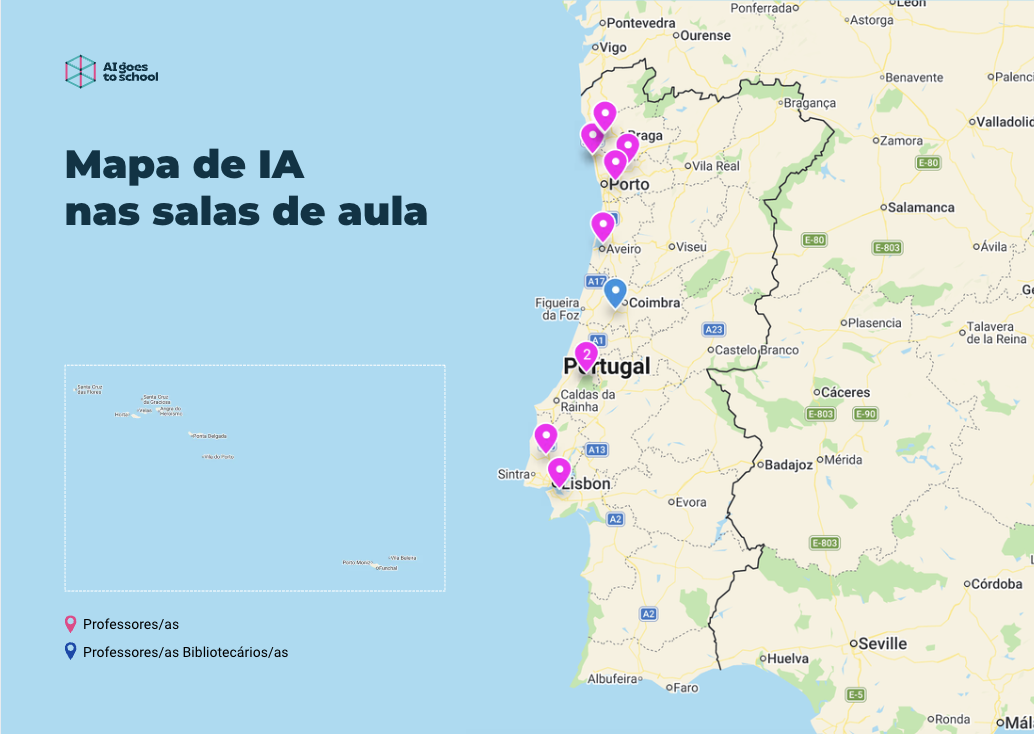
We have launched the first edition of the interactive map of AI in classrooms in Portugal, and newsletter subscribers are the first to hear about it, before we announce it on our social media. On Monday, 5 October, World Teachers’ Day, the map will be launched on our social media!
Each point on the map represents a teacher or school librarian who has already taught about AI or with AI, and has shared their lesson plan with AI goes to school. Every entry is curated by Marta Pinto, with special attention given to those that put pedagogical purpose at the centre, combined with a responsible, critical and ethical use of AI. The map in numbers: 13 lesson plans · 12 teachers · 12 educational institutions · 7 districts.
And the map will keep growing throughout the school year. To add your lesson and school, fill in the form. It takes less than 10 minutes.
Try it! A shared compass for AI literacy.
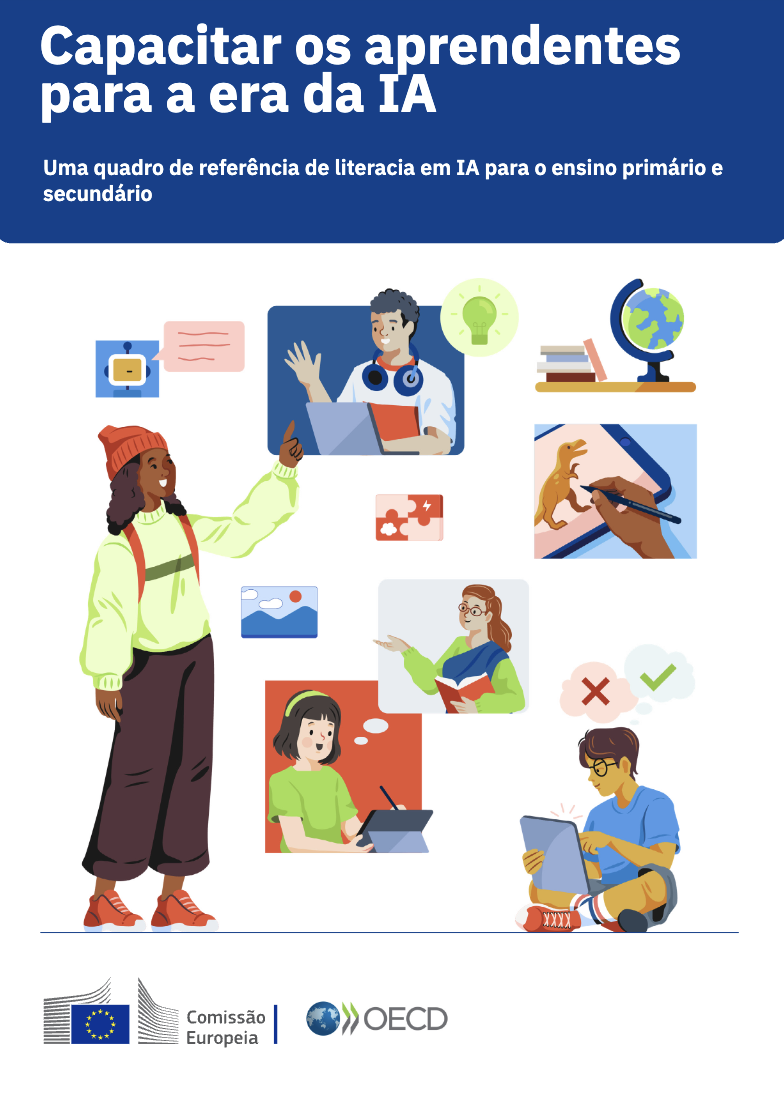
The AI Literacy Framework was published by the European Commission and the OECD as a reference framework for AI literacy in primary and secondary education, and is now available in Portuguese. It has four core domains: engaging with AI, creating with AI, managing AI and designing AI.
What to look at first: the tables with ready-to-use ideas “In the classroom”. One example is “AI for Oceans”. The interactive filtering tool is, for now, only available in English.
Portugal: AI for Oceans in a primary school classroom.The educational game “AI for Oceans” has already been brought into a Portuguese primary school classroom by teacher Cláudia Meirinhos. Her pupils trained real machine learning (AI) models “through play”: they discussed whether the data was sufficient, whether it is fair to choose fish by their shape or colour, and what it means to use AI for good. See the full lesson plan.

Teacher Reflections
A pedagogical shift! Susana Brás, a higher education teacher, made a pedagogical change with one central goal: to focus students’ attention on the process that led to the final result. Read the full reflection.
“One change I made with AI was simple… I don’t ban it, I encourage it, but with rules. I believe this approach has had some impact because students stopped being afraid to say they had used it, and started arguing how they used it, what worked, and what produced unacceptable results. (…) The value of the project, therefore, does not lie in reaching a perfect solution. It lies in the ability to build a well-grounded solution, understand its limitations, learn from the process and communicate that reasoning clearly.” Professor Susana Brás, higher education, 2026.
The goal is to teach! Ben, a Geography teacher with more than 15 years’ experience, tested an AI plug-in to mark his students’ work, but decided not to use it because he believes that doing the marking himself is essential to getting to know each student. Read the full reflection.
“I tried using AI for things like feedback to students and I was genuinely surprised. We had a 10-point geography assignment in Google Docs. I thought the AI would be a disaster, but I put in a list of criteria I wanted it to assess and the comments were spot on. In fact, there were a few things it picked up on that I felt I should have focused on more myself. So I showed it to the students, who were also really impressed. And I told them that, from a moral point of view, I find this a bit strange. I’m not going to use AI marking with them. I want the students to know that I’m working for them when it comes to building relationships. I don’t want them to think that all they have to do is go home, press a button and their work gets marked.” Ben, Geography teacher, 2024.
Student Stories
One in four Portuguese teenagers turns to ChatGPT for emotional support. A national study by EU Kids Online Portugal (NOVA FCSH), with 2,111 children and young people aged 9 to 17, shows that 85% already use generative AI, above the European average. Almost half use it for schoolwork; one in four uses these tools for emotional support. It is no reason to panic, but it is a useful warning sign: for some students, this may already be one of the closest relationships in their daily lives. Teachers should know about this. Read the report by Ponte, Batista & Luna, 2026.
An AI policy written entirely by students. Students from all 50 US states came together to jointly draft a national framework of AI recommendations for education policymakers in American schools. The text, the STUDENTS FIRST Act of 2026, was approved by 82 votes to 16 by a “Student Senate” with two representatives from each state. Key measures drafted by the students:
- Authentic learning: from 9th grade onwards, AI only with teacher permission, for brainstorming, studying and editing, never to replace original work.
Early literacy: mandatory AI training from students’ first contact with digital devices at school, for both students and teachers.
Privacy and identity: students must know what data about them is collected and how it is used; if accused of misusing AI, they have the right to appeal, with guaranteed human review.
High-stakes decisions stay with humans: grades, discipline and hiring must never depend on AI alone. Even when teachers use it to plan lessons or give feedback, they remain responsible for reviewing everything.
Emotional support cannot be delegated: AI does not replace school psychologists or trusted adults; students who need real support should be referred to qualified professionals.
News
UNESCO: 700 students gathered at UNESCO headquarters in Paris to discuss their future with AI with experts, at the start of the new school year.
USA: The New York City and Los Angeles school districts have restricted the use of AI in classrooms for students up to 8th grade. There are still many exceptions, but it is a sign of slowing down after years of rapid adoption.
Portugal: Portugal has signed the international declaration for safe AI, which calls for coordinated joint action between industry, governments and society. The aim is to strengthen oversight without increasing inequalities. (24 September 2026)
What Science Says
Your brain on ChatGPT. A study by the MIT Media Lab followed around 55 university students as they wrote essays under three conditions: with ChatGPT, with internet search, or without any tools. Each participant wrote essays over several sessions spanning months. In a fourth session, the roles were swapped: those who had used ChatGPT wrote without help, and vice versa. Brain activity was measured using electroencephalography (EEG) and the essays were assessed by teachers.
Key findings:
- Less external support, more brain activity. The no-tools group showed the strongest and most widespread brain networks, the internet search group was in between, and the ChatGPT group showed the weakest engagement.
Weaker memory and ownership with ChatGPT. Most users struggled to accurately quote what they had written and felt less ownership of and satisfaction with their work.
Order matters. Students who first wrote on their own and only then used ChatGPT showed better memory and broader brain activity than those who started with AI.
“Cognitive debt”. This is the name the authors give to this effect.
Kosmyna, N., Hauptmann, E., Yuan, Y. T., Situ, J., Liao, X.-H., Beresnitzky, A. V., Braunstein, I., & Maes, P. (2025). Your Brain on ChatGPT: Accumulation of Cognitive Debt when Using an AI Assistant for Essay Writing Task. arXiv:2506.08872. https://arxiv.org/abs/2506.08872
Coach, not crutch. A review article in Science News brings together several recent studies on AI and learning, including the study shared in our September newsletter (Bastani et al., on mathematics students). The conclusion repeats across very different fields: doctors who relied on an AI to detect polyps during colonoscopies “forgot what to look for” once they could no longer use AI; students who practised for a reading test with AI support gave up more easily on difficult questions after the AI was taken away. But there is an encouraging counterpoint: when AI provides hints instead of ready-made answers, students seem to learn just as well as when they have no access to technology.
“If you’re not engaging in the cognitive work, you’re not going to learn the skill.” (Trent Cash, behavioural scientist)
Quote of the Month
“We need to educate a generation of children who know that they are the ones who can write, and even rewrite, the rules of AI.” Randi Williams, AI and education researcher. (Watch the full TED Talk)