
Newsletter #4, November 2026 ✦
The AI in classrooms map keeps growing: 17 lesson plans and counting!
Map of AI in classrooms in Portugal
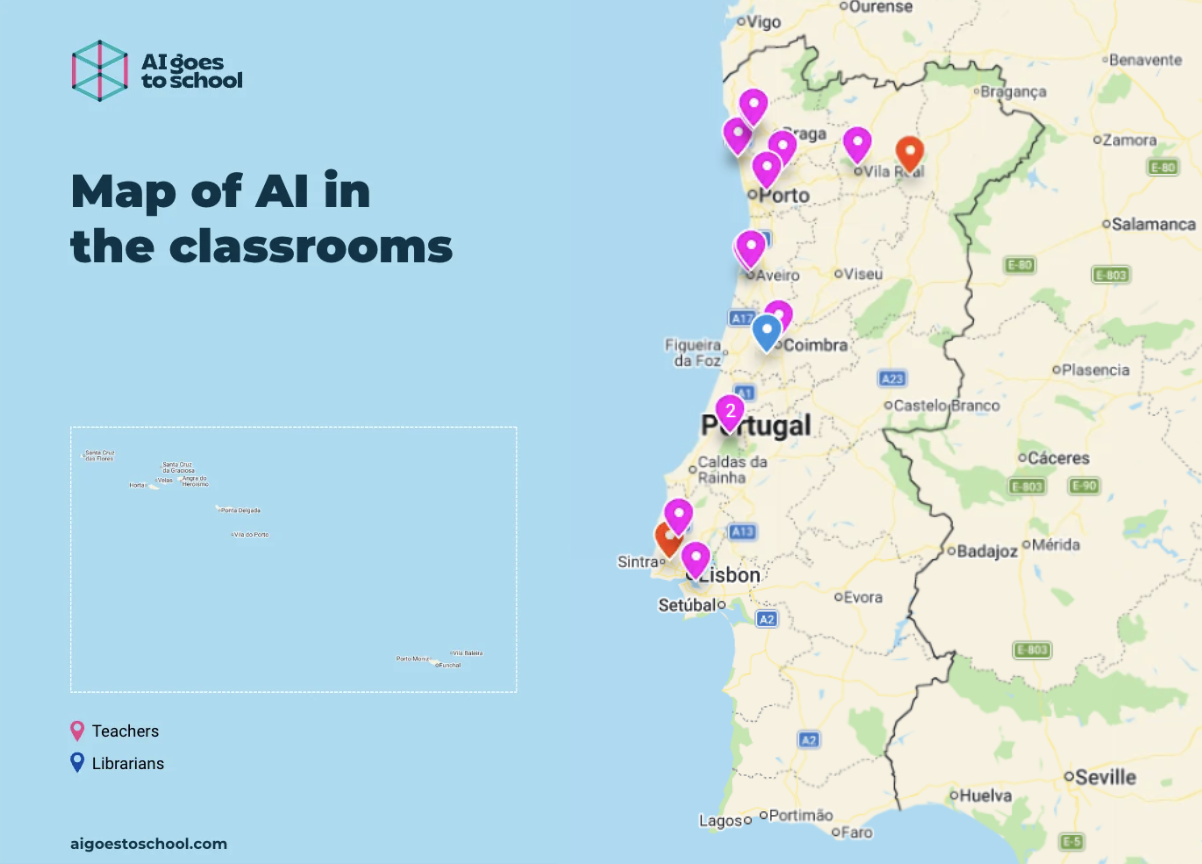
In September, AI goes to school launched the 1st edition of the interactive map of AI in classrooms in Portugal, featuring 13 lesson plans from teachers and school librarians across the country. Since then, the map has grown: the October and November updates added four more lesson plans, bringing the total to 17 shared lesson plans.

New lesson plans on the map
Future primary school teachers build an AI tutor for lesson planning
Professor Marco Bento · Higher Education
¡Descubre Sevilla con Manolo! Building an AI chatbot to learn Spanish
Teacher Cátia Pimenta Valéria · Year 10
Doing schoolwork in a world with AI without losing authorship
Teacher Librarian Carlos Pinheiro · Secondary Education
Ubuntu Vibes: students design activities using AI responsibly
Teacher Cristina Oliveira · English combined with Citizenship and Development, Year 12
These plans add to the diversity of the map, which now covers all five levels of education, from primary school to higher education, including the school library. The map shows how AI can be used in the classroom in a critical, ethical and responsible way.
Explore the map. Each pin represents a teacher.

Try it in your classroom

Two activities developed by two teachers in their own classrooms with secondary school students. Try them in your classroom and adapt them to your classes.
Activity 1
The AI Traffic Light
Created by Teacher Librarian Carlos Pinheiro
Students work in groups and are given a traffic light with three options to help them decide when they can or cannot use generative AI for an assignment:
- NOT ALLOWED
- ALLOWED WITH RESTRICTIONS
- ENCOURAGED
The teacher presented a series of situations, such as:
- Asking AI to write the entire assignment.
- Asking for suggested research questions.
- Using AI to improve the clarity of your own text.
- Using AI in a test without permission.
- Asking AI to critique the arguments in an assignment.
After each situation, students chose the AI traffic light colour they thought applied and explained their choice.
Key message
The question isn’t just “Can I use AI?”. It’s “What for, and under what conditions, can I use it in this task?”
Activity 2
Use AI responsibly
Created by Teacher Cristina Oliveira
In this lesson, students could use a generative AI tool of their choice to carry out their research.
Use AI responsibly
You can use ChatGPT, Copilot or Perplexity to get ideas, formulate research questions, organise your work and get language support.
Follow this process:
Check important facts against at least TWO reliable sources. Don’t copy AI-generated text as if it were your own.
For the output generated by AI, each group had to confirm the information in at least two reliable and relevant sources.
Teacher reflections
Professor Marco Bento reflects on the lesson plan Future primary school teachers build an AI tutor for lesson planning
“This experience led me to one central reflection: perhaps one of the most important skills for future teachers is not knowing how to get answers from Artificial Intelligence, but knowing how to ask pedagogically intelligent questions.
Over these ten sessions, the most interesting change didn’t really happen in the tool. What changed was the way students thought before writing a prompt.
In the first attempts, the tendency was to ask the technology for a product: ‘Make a lesson plan.’ Gradually, they began to provide context, set criteria, question options, ask for justification and, above all, disagree with the answers they were given, and that is perhaps where the most important learning lies.”
Professor Marco Bento, Escola Superior de Educação de Coimbra
Teacher Cátia Pimenta Valéria reflects on the lesson plan ¡Descubre Sevilla con Manolo! Building an AI chatbot to learn Spanish
“Some experiences don’t end when they’re over; they stay with us, come back later and ask to be rethought. That was the case with this activity, which began in 2023/2024 and was taken up again, revised and expanded in 2025/2026.
From the first time I ran it, I came to realise that the most interesting part wasn’t just the use of Artificial Intelligence, but what it could make possible when it was used with purpose, connected to the curriculum and to a real learning situation.”
Teacher Cátia Pimenta Valéria, Escola Secundária de São Pedro
Students

National Walkout to Freeze AI
Students want to be heard: they are paying attention and thinking critically about the space AI is taking up in school.
100 students from an arts high school in the United States walked out of class in protest, saying AI is being imposed on them and demanding a pause. They say the school is using AI for things the students themselves could do, especially arts students. They pointed to school event posters made with Canva AI and ChatGPT, and even campaigns with AI-generated music.
These students walked out alongside students in more than 50 cities, in a movement called the “National Walkout to Freeze AI”. The movement brings together several causes related to the negative impact of AI with environmental and social concerns.
News highlights
United States
Google wants to switch off search for schools that want to switch off Gemini AI in Classroom
Schools and parents want to be able to switch off Gemini AI in Google Classroom. They are demanding that Google give schools the option to turn off AI for all students. But the company did not welcome the demand and now says it will let schools turn off AI, but in doing so Google will also turn off the search engine.
This demand follows a news report about a 13-year-old girl who planned to end her life after chatting with Google’s artificial intelligence on the Chromebook her school had given her, and about the lawsuit her family filed against Google.
What if it happened in Portugal?
For now, this only applies to the United States. What if it happened in Portugal? What can we do?
Digital literacy also means understanding that there are several providers of any technology, tool or service; that’s why learning to use different tools is essential, so we can choose the one that serves us best. Perhaps it’s time to choose a search engine that collects less search data and personal data from its users. There are several alternatives.
Portugal
Guidelines for the responsible use of AI in schools open for public consultation until 30 November
EduQA has opened a public consultation on its guidelines for the responsible use of AI in education, for public and private schools from pre-school through primary and secondary education. The document calls for safe, critical and age-appropriate use that supports learning without replacing independent thinking, creativity or the role of teachers.
It proposes three levels of AI use in activities, set by teachers:
It also includes personal data protection measures and practical tools for students, teachers and schools. In pre-school, it does not provide for children to use AI tools directly and independently.
Teachers have until 30 November to share their input. The final version is expected to be published on 4 January 2027.

Add your lesson plan to the map!
Every lesson plan shared with AI goes to school helps a fellow teacher take the first step, try a new idea or look at AI in a different way.
Do you use AI in your lessons, or teach your students to think critically about it? Share your lesson plan and put your school on the map. It takes less than 10 minutes.
Did someone forward you this newsletter? Subscribe to the newsletter